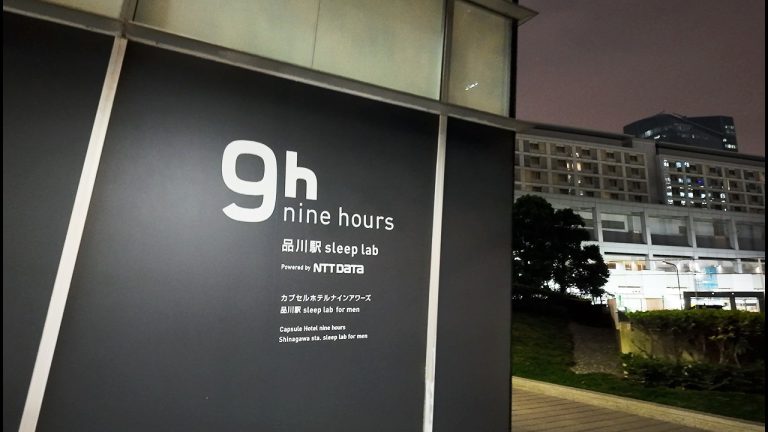
The 10th-floor Sky Lounge at Nine Hours Hamamatsucho has a direct, unobstructed view of Tokyo Tower from window seats, close enough that the orange winter illumination fills the glass completely. Guests have exclusive access to the rooftop above it — 360 degrees, no queue, and nobody else there on a weeknight. For a capsule hotel at this price point, that view alone justifies the booking. The capsule design itself, created by product designer Fumie Shibata — the same person behind Muji’s Body Fit Sofa and KINTO bottles — gives the space a considered quality that is not standard for the category. This is the combination that makes Nine Hours Hamamatsucho work.
Overview
The hotel opened in 2020 and sits about 220 meters from Hamamatsucho Station’s North Exit — roughly a 3-minute walk, passing through an area where Tokyo Tower is already visible from the main road. Daimon Station on the Toei Oedo Line is similarly close. Note: the Monorail Hamamatsucho Station’s north entrance is currently under reconstruction, with a new pedestrian walkway scheduled for completion in 2026. The property is men-only on the sleeping floors, which are QR-code protected. Gender separation is enforced from the locker area upward; the 10th-floor lounge is co-ed and also open to non-guests at ¥300 per hour.
The lounge is designed with interior elements borrowed from airport and major terminal architecture — aluminum extrusions and vehicle-sourced parts — to evoke the atmosphere of transit spaces where travelers pass through. All seats have power outlets and reliable WiFi. The 8th floor adds a separate desk area with an atrium and natural daylight; eating and drinking are restricted to the 10th floor only, so convenience stores nearby cover any gaps. A breakfast add-on plan links to the morning set at a nearby Tully’s Coffee, which is a reasonable option for the price. There is no microwave or kettle on-site.
Room & Amenities
The capsule unit is 105cm wide, 215cm deep, and 102cm tall — standard for the category. What distinguishes it is the form: soft rounded edges, no sharp corners, and a cocoon-like shape that makes crawling in feel deliberate rather than claustrophobic. Upper bunk placement means no falling-out risk. The croissant-shaped pillow is engineered with five different materials divided into eight sections and a crescent curve designed to support natural rolling over during sleep. An adjustable lighting knob overhead and small horizontal surfaces on both sides for a phone complete the essentials. A roll screen provides privacy from the shared corridor.
At check-in, the receptionist walks through how everything works in detail, which is helpful if it is your first time. Earplugs arrive packaged in a lottery-style box — a small design touch that is consistent with the rest of the property’s tone. The locker on the 2nd floor contains the amenity bag: disposable slippers, a black two-piece stretch lounge set (default size L, exchangeable at the front desk), and three UCHINO-collaboration towels — one bath, one face, one bath mat — notable for being unusually soft, light, and absorbent. A toothbrush is handed over at the front desk; shavers and a 4-piece skincare set (makeup remover, face wash, lotion, emulsion) are available for purchase. Everything used during the stay returns to the bag at checkout.
A few practical notes: the lockers are on the narrow side, and bulky winter luggage may not fit easily. Large suitcases can go underneath the locker units, though there are no visible wire locks in that area. There is only one elevator serving the building, and morning congestion is a real consideration if you are trying to shower and check out efficiently. Each sleeping floor has a veranda accessible just past the capsules, which provides a useful sense of outdoor space that most capsule hotels do not offer.
The shared shower room has washbasins and individual shower booths side by side, available without reservation. The TOTO shower delivers a continuous pillar of warm water with strong pressure; there is also a rain shower head. Shampoo, conditioner, and body wash are fig-scented and silicon-free. The shower booth doubles as a changing area. Cleaning runs daily between 11AM and 3PM; conditions outside that window depend on previous guests. Hair dryers are provided.
Dining & Breakfast
Byron Bay Coffee Daimon is just around the corner from the hotel and was the obvious morning stop. The shop is the Tokyo outpost of a coffee brand started on a family-run organic coffee farm in Byron Bay, the easternmost point of Australia — which is also where the Flat White originated. The version here has less milk than a latte, finer and creamier foam, and a velvety texture that holds up well alongside a ham and cheese sandwich with mustard. It is genuinely popular: there was a significant queue by 8AM. A window seat inside gives a calm start to the morning.
For dinner, the walk to Tokyo Tower — about 20 minutes from the hotel — is worthwhile in itself, and the Foot Town food court at the tower’s base offers a practical option without the need to go far. Umeiya ramen specializes in Tonkotsu, and the Black Tonkotsu with a soft-boiled egg is the standout: Hakata-style broth with ma-yu, a charred garlic oil originally from Kumamoto ramen that turns black through complete carbonization. The result is a broth that reads as a drinkable stew rather than a conventional soup base, clinging to ultra-thin straight noodles boiled slightly firm. It is a good bowl. The food court is relaxed on weeknights, with seating available and a simple touch-panel ordering process.
Location & Access
Hamamatsucho functions as a transit hub — JR Yamanote and Keihin-Tohoku Lines run through the main station, with monorail connections to Haneda Airport. The hotel’s position means it is practical for pre-flight use; several large suitcases in the locker area on my visit confirmed this pattern. Tokyo Tower is close enough to see clearly from the street intersection near the hotel, and the 20-minute walk through Daimon and Shiba Park is a worthwhile evening route rather than a detour.
Shiba Park is one of Japan’s oldest, designated in 1873 alongside Ueno and Asakusa as the country’s first public parks. Large camphor, zelkova, and ginkgo trees throughout the grounds give a sense of age that contrasts with the modern towers around it. The Former Taitoku-in Mausoleum Somon Gate at one corner is a designated Important Cultural Property. In December, a German-style Christmas market appears in the park, and the area is known as a filming location for several TV dramas.
Tokyo Tower itself (333 meters, completed 1958, approaching its 70th anniversary) is worth spending time inside on a clear winter night. The Main Deck at 150 meters gives the night view its best conditions — low humidity and reduced particulates in cold air make the city lights sharper than at any other time of year. Tower Daijingu, located on the Main Deck and enshrining Amaterasu Omikami invited from Ise Jingu, claims the distinction of being the highest shrine in Tokyo’s 23 wards. The goshuin here includes seasonal versions and zodiac designs; the Sunrise Goshuin depicting Tokyo Tower alongside Mount Fuji at sunrise is a specific and attractive stamp. The Top Deck at 250 meters requires a reservation-only tour. Histories Alley on the ground floor shows archival photographs from the tower’s 1958 opening, including a period when elevator attendants — now vanishingly rare, surviving only at Nihonbashi Takashimaya in Tokyo — operated the lifts.
Final Verdict
Nine Hours Hamamatsucho is one of the better-positioned capsule hotels in Tokyo: genuinely close to a major transport hub, with a design quality that sets it apart from the functional-only end of the category, and a rooftop lounge view of Tokyo Tower that most full-service hotels in the city cannot replicate at any price. The lockers are narrow, the single elevator is a bottleneck in the mornings, and there is no in-room food or beverage setup — all standard capsule hotel trade-offs that are worth knowing before booking. Rates vary by season — check current prices on Agoda. For a base that combines Haneda Airport access, a coherent design sensibility from Fumie Shibata, and a near-private view of Tokyo Tower from the 10th floor, the case is easy to make.