Grand Prince Hotel New Takanawa is one of the final works of Togo Murano, widely considered one of Japan’s most significant architects of the twentieth century. Completed in 1982 when Murano was 91 years old, the building is immediately identifiable by its semicircular balconies, which stack along the entire facade in a rhythm resembling white waves — each one finished with delicate lace-like ironwork that Murano used throughout the structure as a signature of his approach to materials and human scale. The Hiten banquet hall in the basement has a ceiling covered entirely in abalone shells. The Main Bar Asama retains its original Murano-designed lighting fixtures and bar chairs. These are not decorative touches — they are the considered decisions of an architect working at his absolute peak. I’m telling you this upfront because the hotel is scheduled for demolition at the end of March 2027 as part of the Shinagawa area redevelopment, and the window to experience this building as a working hotel is limited. A stay here is not just a hotel visit; it is an encounter with a piece of Japanese architectural history that will not survive the decade.
Room & Amenities
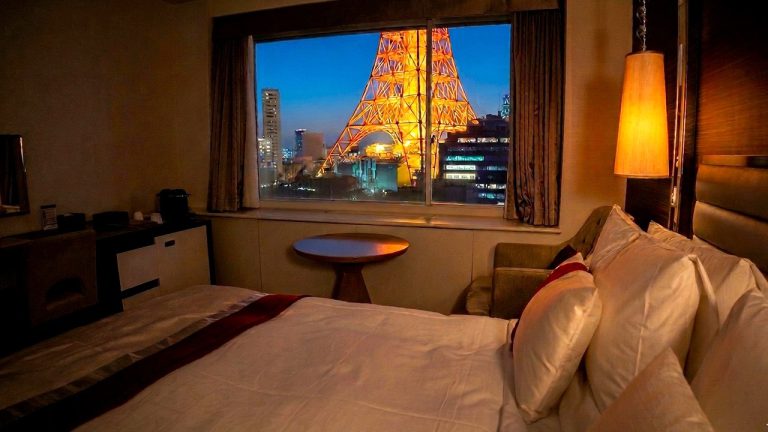
The Superior Corner King Room on the 11th floor is approximately 39 square meters — the reviewer noted it was “more than twice as large” as a typical business hotel room, and that sense of space is immediately felt. Even with a king-size bed and a sofa occupying the main area, the room doesn’t feel crowded; the proportions allow for easy movement and the air to feel genuinely calm. Four pillows are provided. Dimmable lighting is controlled via a knob at the bedside. The chic interior uses soft, warm tones with careful lighting rather than conspicuous decoration. The balcony — Murano’s semicircular design, with the characteristic ironwork visible up close — opens to a view of the Japanese garden below and the surrounding Takanawa hills.
The TV cabinet contains both a safe and a full mini-bar setup. Complimentary bottled mineral water is provided. Nightwear is a one-piece gown, with a yukata available on request. The bathroom is a modular unit but considerably more spacious than the standard business hotel equivalent; a wide mirror adds visual depth to the space. Toiletries are from POLA — shampoo, conditioner, body soap, and a full skincare set including cleansing oil, lotion, and milk — which is a thoughtful step above the generic toiletry packages most hotels at this tier provide. Cotton swabs, body towels, and the full range of basic amenities are provided. The combination of the Murano-designed room proportions and the POLA toiletries gives the room a coherent premium identity that feels curated rather than assembled.
Facilities & Common Spaces
The hotel operates as part of what locals call the “Prince Village” — a cluster of three properties sharing the same Japanese garden grounds: Grand Prince Hotel New Takanawa, Grand Prince Hotel Takanawa, and The Prince Sakura Tower Tokyo. Guests of each can use certain shared facilities across all three, which in practice means access to the sauna and spa at The Prince Sakura Tower Tokyo. A 24-hour fitness room with two treadmills and two bikes is on site. A convenience store operates in the basement from 7:00 AM to 1:00 AM. The private nursing and baby-changing room near the elevator is a practical amenity for families.
The Momiji lounge, adjacent to the lobby, is a modern Japanese space with high ceilings and floor-to-ceiling windows overlooking the garden. Open from 10:00 AM to 9:30 PM, it serves lunch and dinner as well as coffee and desserts — a strawberry tart was consumed on-site during this visit with no regrets. At night, the garden illumination seen from the windows creates a particularly atmospheric setting. The Main Bar Asama — the Murano-designed bar behind the large Keizo Koyama mural at the entrance — is open evenings only and warrants a dedicated visit: the lighting fixtures and bar chairs are original Murano works, and the classical bar space represents exactly the kind of craftsmanship that will be lost when the building is demolished. Do not skip it.
Dining & Breakfast
Breakfast is served across three different restaurant venues, with Buffet Zakuro cited as the most popular. Service begins at 6:30 AM. The buffet includes over 50 Japanese and Western dishes, anchored by a live kitchen where chefs prepare items directly in front of guests. The made-to-order omelet station is the highlight — fluffy, freshly made, with multiple topping and sauce options. Donuts, Japanese curry, and soba are among the supporting cast. The quality, as the reviewer noted, reflects the standards of a long-established hotel: the ingredients and execution are a step above what a buffet of this format often delivers. Some guests pair the fresh omelet with curry for an unofficial signature dish.
The Japanese Garden
The pond-stroll garden shared between the three Prince hotels is one of the most unexpected pleasures of staying here. During the winter visit, over 400 bamboo lanterns lit the garden in the evenings, creating a soft, almost otherworldly atmosphere inspired by the Edo-period “Nijurokuya-machi” moon-watching tradition that was historically practiced in the Takanawa area. A wooden bridge crosses to a Sanmon gate; beyond it sits a bell tower and Kannon-do, both designated as Tangible Cultural Properties of Minato Ward. When the hotel is demolished in 2027, the Kinkokan hall and the tea room within the garden will be preserved — but the balconied building and the Murano interiors will be gone.
Location & Access
The hotel is approximately 7 minutes’ walk from Shinagawa Station’s Takanawa Exit, up Zakuro-zaka Slope. Shinagawa Station connects the JR Yamanote Line, JR Tokaido/Sanyo Shinkansen, JR Keihin-Tohoku, and the Keikyu Line — the Keikyu Limited Express reaches Haneda Airport in approximately 16 minutes. A complimentary shuttle bus runs every 20 minutes from the main entrance of the adjacent Shinagawa Prince Hotel. Parking is available on the hotel grounds. The area is quiet and residential in character, elevated above the busier district around the station, which contributes to the overall sense of retreat that the property generates.
Final Verdict
Grand Prince Hotel New Takanawa is, in the plainest terms, one of the most architecturally significant hotel buildings in Tokyo, and it will not be there for much longer. A stay at approximately ¥25,000 per night (approx. $165) during a New Year’s special deal represented exceptional value for what the property delivers — a 39-square-meter Murano-designed room, POLA toiletries, access to the spa at The Prince Sakura Tower, a comprehensive breakfast buffet, and the Japanese garden with its bamboo lanterns in the evening. The walk from the station and the modular bathroom are the only practical compromises in an otherwise outstanding stay. Rates vary by season — check current prices on Agoda. If you have any interest in staying here, the timeline is clear: operations cease at the end of March 2027. This is a hotel worth visiting precisely because it will soon be impossible to do so.