OMO7 Yokohama by Hoshino Resorts is housed in the former Yokohama City Hall — a 1959 building designed by architect Murano Tōgo as part of the city’s centennial, closed in May 2020, and now reborn as one of the most architecturally significant hotel openings in recent Japanese hospitality. The renovation concept, described as “Grafting Design,” treats the historic structure the way a horticulturist treats a graft: the original organism is preserved and the new growth is joined to it rather than replacing it. Deep blue ceramic tiles surround the elevator banks; the original civic hall clock is mounted in the lobby; the grand staircase has been relocated and reconstructed within the central atrium; room number signs carry Murano’s original design language. The ceiling height in the Katariba Room — 55 square metres on the eighth floor — is, as the reviewer noted, possibly the highest they had encountered in any hotel room. That height comes directly from the original City Hall structure, and it is extraordinary.
Room & Amenities
The Katariba Room — “katariba” meaning “a place for conversation” — is built around a curved semicircular sofa table at its centre, designed to facilitate exactly the kind of extended, unguarded conversation that hotel rooms usually make awkward. The room accommodates up to four guests; two sofas at the back of the space convert into beds for additional occupants. For two people, the 55 square metres feels genuinely generous rather than aspirationally described. Room colour themes are drawn from the original civic building: red from the council chamber carpet, blue from the ceramic tiles, green from the council seats. The eighth-floor room is blue — and the window frames Yokohama Stadium directly, where the DeNA BayStars play in Yokohama Blue. The conceptual coherence is total.
Every room comes equipped with an air purifier and built-in humidifier as standard. The electric kettle is accompanied by Mawal mugs — a sustainable tableware brand using plant-derived cellulose resin — a conscious material choice that reflects the hotel’s broader sustainability orientation. A mini fridge is tucked behind a wooden door alongside a pitcher (filled from floor-level water dispensers, as the hotel moves toward eliminating single-use plastic bottles) and a freezer compartment. A small flashlight is positioned next to the safe — a practical safety detail that is easy to overlook and genuinely useful. Twin beds each have dimmable reading lights, individual power outlets, and USB charging ports. A master light switch positioned between the two beds controls the entire room’s lighting, so neither guest needs to get up to turn off the lights. Pillow options are firm or soft.
The bathroom is a full three-way split: separate toilet, bath, and vanity. This configuration is rare in Japanese hotels outside the luxury category and makes a tangible difference when sharing a room — two people can use the bathroom simultaneously without any overlap. The bathroom ceiling is high, consistent with the rest of the room. The bathtub is deep and designed for a proper soak. Gripping handles and safety rails are installed. The shower features a large shower head with a proper washing area rather than a curtain arrangement. Body wash, shampoo, and conditioner are provided; skincare products are not (bring your own). The toilet is a tankless bidet model. A roll-down privacy screen separates the vanity area from the main room. The Panasonic Nano Care hair dryer is a quality specification. Two-piece gauze pajamas with an embroidered OMO logo are provided — the gauze fabric is soft and comfortable to wear.
The hotel’s 276 rooms span nine types, including a Yagura Room with ceilings 1.5 times higher than the standard and a loft configuration, and dedicated dog-friendly rooms on a designated pet floor that accommodates up to two dogs of any size with both indoor and outdoor dog facilities. The amenity corner in the common area operates on a take-what-you-need sustainability model — toothbrushes, cotton pads, hair brushes, and green tea bags are stocked, with the expectation that guests take only what they will use. The Smart Laundry on the 5th floor uses alkaline ionised water with no detergent — described as a first for the Japanese hotel industry — and its interface supports Japanese, English, Chinese, and Korean. Cashless payment only. Ice machines and water dispensers are available on every guest floor. Vending machines carry soft drinks and accept both cashless and cash payment.
Rooftop & Common Spaces
The rooftop terrace — approximately 45 metres in length — was previously inaccessible during the City Hall era and has been transformed into a guest-only outdoor space that serves as the setting for “Hama Night,” a nightly jazz event running from 7:00 to 10:30 PM with live performances every Friday and Saturday. The HAMAKAZE Kitchen operates during Hama Night serving craft beer and light snacks. On rainy evenings, the event moves to the OMO Base in the lobby, which explains the ambient jazz the reviewer encountered upon returning from dinner. The rooftop provides a direct aerial view down into Yokohama Stadium — “Hamasta” — which is an experience that requires no interest in baseball to appreciate. During match days and fireworks events, the perspective from directly above the stadium is described as spectacular. The observation deck section of the rooftop is exclusive to hotel guests.
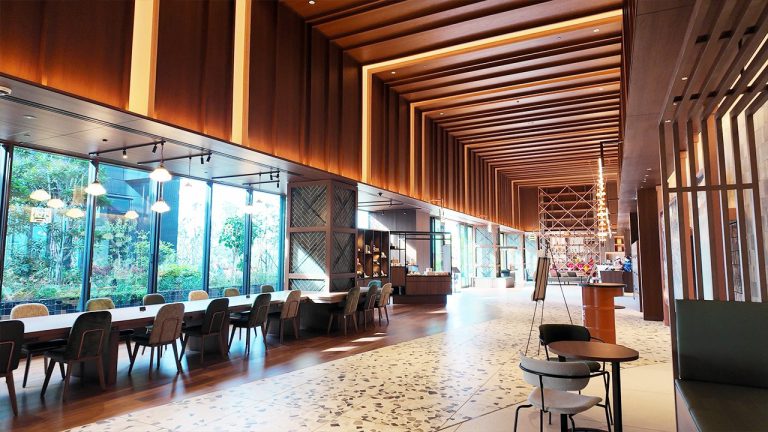
The OMO Base functions as both lobby and neighbourhood planning resource. The “Gokinjo Map” — a staff-curated neighbourhood guide — is displayed here, and QR codes link to restaurant and local information tailored to the Kannaï area. The Library Lounge, accessed at the top of the reconstructed grand staircase, holds Yokohama-themed books — music, shumai, local history — and an artwork that once hung in the original civic hall. Private hourly rental of the Library Lounge is available. Complimentary popcorn is offered in the lobby. A free 70-minute “Yokohama Legacy Walk” guided architecture tour explores the building’s history and Murano’s design language; advance booking is required.
Dining & Breakfast
Breakfast at OMO Dining on the 2nd floor is served from 7:00 to 10:00 AM under the title “Yokohama Morning Specialties” — a buffet of 50+ items drawing from both classic breakfast formats and local Yokohama food culture. The live kitchen produces dishes to order; a salad bar uses fresh produce sourced from Kanagawa Prefecture; a dim sum station reflects Yokohama’s Chinatown connection; a vegan curry is available for dietary preference; a congee option is included for guests who prefer something gentle. Shonan Gold juice — a citrus variety developed by Kanagawa Prefecture over 12 years from a cross between Golden Orange and Unshu Mikan — is a locally specific offering worth trying. The tableware is elegantly chosen, consistent with Hoshino Resorts’ characteristic attention to how a breakfast table looks. The dining room’s blue tiles echo the original civic hall. Jazz plays throughout. A lighter alternative is the OMO Bakery on the 1st floor: two deli items, soup, drink, and freshly baked bread.
For dinner, THE LIVE — the three-floor BayStars entertainment venue directly connected to the hotel via BASEGATE Yokohama Kannaï — contains nine restaurants and stalls. The yakitori izakaya “Ginmi Shite Kaorusu,” originating from Yokohama’s Noge district, serves a BayStars collaboration shio-nikomi that reportedly sells out 300 servings daily, alongside yakisoba topped with a star-shaped omelette. Player-produced dishes and team drinks add to the atmosphere. Even without a live game, the venue’s giant screens, energy, and BayStars-themed food make it a compelling dinner option that the hotel’s location makes uniquely accessible.
Location & Access
OMO7 Yokohama by Hoshino Resorts is positioned directly in front of JR Kannaï Station’s south exit — the station is effectively part of the hotel’s immediate exterior. The surrounding Kannaï area has a distinct character from Minato Mirai: the Noge district, a 10-minute walk west, has approximately 600 restaurants and bars in a dense network of retro standing bars and neighbourhood izakaya. Yokohama Chinatown — about 15 minutes on foot — is directly accessible from the hotel as a dining destination, and the hotel’s staff recommendations via the Gokinjo Map provide curated guidance on which specific restaurants to visit. Yokohama Stadium is visible from the hotel rooftop and is metres from the front entrance, making game-day stays a naturally integrated experience for BayStars fans.
Final Verdict
OMO7 Yokohama by Hoshino Resorts is not a hotel that happens to be in an interesting building — it is a hotel that is inseparable from its building, and the building is inseparable from the city it served for 60 years. Murano Tōgo’s 1959 City Hall structure provides ceilings that belong in a different category from the rest of the Tokyo-Yokohama hotel market, a three-way split bathroom that most properties at this price would not think to offer, and a design heritage that gives every tile, handrail, and room number sign a story to carry. Hoshino Resorts has added a rooftop jazz event, Japan’s first detergent-free Smart Laundry, a 50-item Yokohama-themed breakfast, a dog-friendly floor, and a neighbourhood map that treats local culture as seriously as the architecture. Rates vary by season — check current prices on Agoda. This is an urban resort that has been thought through at every level, and staying here feels like being part of Yokohama’s continuing history rather than just passing through it.