The defining moment at Keio Presso Inn Shinjuku comes after dark: step outside and the Tokyo Metropolitan Government Building — 243 meters of Kenzo Tange architecture, twin towers said to be inspired by Notre Dame — is running Guinness World Record-certified projection mapping across its entire facade. The 15-minute show cycles through Godzilla, Pokemon, and Japanese festival motifs at a visual and sound scale that is hard to describe until you are standing in front of it. The hotel is literally steps away. Free breakfast is included in the rate. For Shinjuku, this combination is genuinely unusual, and it is the reason this property is worth considering over anything closer to the station.
Overview
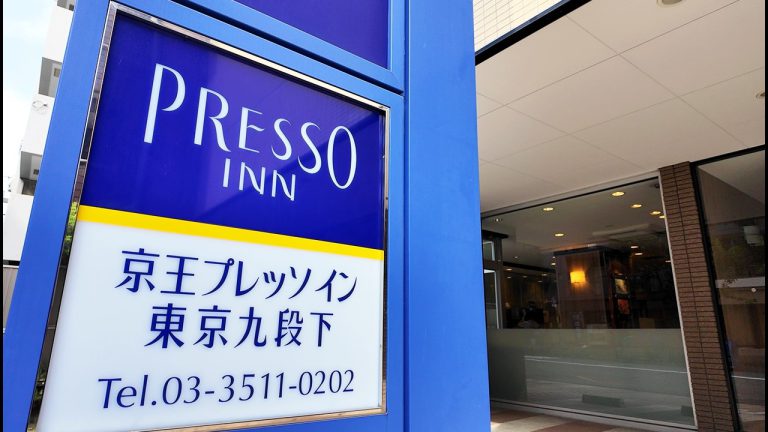
Keio Presso Inn Shinjuku opened in 2005 and is currently undergoing a phased renovation scheduled to complete in September 2026. The 15-story building has 371 rooms. The location is along Koshu Kaido Avenue in Nishi-Shinjuku, about 10 minutes on foot from both Tocho-mae Station (Toei Oedo Line, Exit A4) and JR Shinjuku Station’s South Exit. Toei buses stop directly in front of the hotel entrance. A 24-hour convenience store occupies the ground floor with indoor stair access from within the building, which is a practical feature at any hour.
The hotel entrance is on the 2nd floor, reached by escalator. Self-check-in runs via QR code at machines in the lobby; self-service luggage lockers are available beside them until midnight on both check-in and checkout days. The lobby lounge is an open space facing the windows — quiet and easy to miss, which is what makes it a good place to sit. Each branch of Keio Presso Inn has its own commemorative stamp with illustrations of nearby landmarks; the Shinjuku version features the twin Tocho towers. Amenities are self-service near the front desk — razors, hairbrushes, shaving cream, cotton pads, and cotton swabs, offered in line with an SDGs single-set policy. Skincare products are not included here but are available downstairs at the convenience store. Washer-dryers are on the 5th and 10th floors: 6 machines per floor, 24-hour access, automatic detergent injection.
Room & Amenities
I booked a Single Room A on the 8th floor — 12 square meters, entered with shoes on. (Single Room B is the slippers-and-barefoot variant, for those who prefer that style.) The interior is light wood and white, bright and fresh, consistent with a recently renovated space. Two sliding doors at the window hide the view until you open them: the Shinjuku skyline, and — more usefully — a window that actually opens, held by a stopper so it does not go all the way. In a central Tokyo hotel, openable windows are rare enough to feel like a feature rather than a standard detail, and on a quiet business-district night it makes a noticeable difference.
The 120cm bed has one pillow with a firm, supportive feel. A bedside night panel controls all the room lights without getting up; a hidden USB port sits beside it. The smart TV runs YouTube and video streaming apps — log in with your own account to continue anything mid-series. The desk has rounded corners and comes with a desk lamp adjustable between warm and daylight color temperatures, which is a small but correct touch for a workspace. An Ionity negative-ion hairdryer is stored in the drawer below the power outlet; an electric kettle is in the drawer below that. The mini-fridge does not have a freezer. No complimentary water is provided, but the convenience store is on the ground floor. The closet near the door holds three hangers, a fresh-scented deodorizing spray, and disposable slippers. In-room massage bookings go through the dedicated bedside phone. The one-piece gown nightwear is long and comfortable enough for a relaxed evening.
The bathroom is a standard unit bath — not yet renovated, but thoroughly clean. The standout is the curved shower curtain rail: it bows outward instead of running straight across, preventing water from splashing outside the tub and stopping the curtain from pressing against you while you shower. It also makes the space feel visually larger than it is. The washlet toilet is standard. Shampoo, conditioner, and body soap have a mild floral musk scent. Toothbrushes are in the bathroom rather than the amenity corner. Water pressure is good; the shower lever is a single-control design.
Dining & Breakfast
Breakfast is included in the room rate and served in the café space adjacent to the ground-floor convenience store from 6:30 to 9:30AM. The buffet runs on a “get energetic” concept updated since 2023: Japanese, Western, and Chinese dishes alongside a special curry, meat items, and a Shinjuku-exclusive dish not available at other branches. Other branches have their own exclusives — Yaesu serves diced steak, Ikebukuro runs wagyu menchi-katsu — which suggests genuine effort went into the menu rather than a single template. On my morning: chicken, fish, kinpira gobo (burdock and carrot braised in sesame oil with soy and mirin, a classic Edo-period side dish), natto, a salad bar, yogurt with three sauce options, miso soup from a self-service machine, and standard juice and milk. The window seats are pleasant; a small reserved sign marks your table while you fill your plate. Considering that a free breakfast in central Shinjuku would normally mean coffee and a croissant at best, this is a meaningful addition to the rate. Note: breakfast will not be served in July and August during active renovation periods.
For dinner, Togikai Yokocho on the 1st floor of the Tocho building — a short walk from the hotel, facing the Citizens’ Plaza — is the right choice for an evening that starts with the projection mapping show. Uohide specializes in fresh seafood and Japanese-Western fusion. The sashimi platter included raw octopus with the kind of firm, crunchy texture that is genuinely satisfying; fried fresh octopus arrived after. The thin-sliced roast beef with a raw egg yolk on top is a specifically Japanese presentation — dip it in soy-based sauce, add a side of rice, and it becomes a roast beef bowl in everything but name. Food arrived by serving robot. The window seats inside are timed for the projection mapping show, though reflections make filming difficult. Getting better results means watching from outside, which is its own pleasure after dinner.
Location & Access
Nishi-Shinjuku is Shinjuku without the station noise. The Tocho-mae Station on the Toei Oedo Line connects to Roppongi, Daimon, and Hikarigaoka. The 10-minute walk to JR Shinjuku Station’s South Exit passes the Mode Gakuen Cocoon Tower — the spiraling glass structure familiar from LEGO Architecture sets — and arrives at LUMINE, where the South Exit and the bus terminal separate. Shinjuku Station holds a Guinness World Record of its own as the world’s busiest station, served by multiple competing railway companies. The area around the hotel has a developed underground walkway network useful in bad weather, though the street-level route is equally fast on a clear day.
The Tocho building itself provides a free observation deck at 202 meters — one of the few viewpoints in Tokyo that costs nothing. The projection mapping on the east wall began in 2024 and now runs year-round, multiple times daily. The Guinness World Record is for “largest permanent architectural projection mapping.” The February 2026 program included a new Japanese-motif festive work alongside rotating themes that have included Godzilla and Pokemon. Each show runs 15 minutes; check the official website for current schedules. Shinjuku Central Park and Yoyogi Park are both walkable from the hotel, adding accessible green space to a district that otherwise reads as corporate. The New National Theatre, which programs ballet and opera, is also within walking distance — a combination of cultural options that is not typical of Shinjuku hotel zones.
Final Verdict
Keio Presso Inn Shinjuku is a practical and quietly distinctive choice in a neighborhood where most hotels either lack character or charge for it. The 12-square-meter room is compact and honest about it, the renovation is still in progress, and the amenity selection is intentionally minimal. What the hotel offers in return is a free breakfast that is better than the category standard, an openable window in a city where that is genuinely uncommon, and a location that puts a Guinness-record projection mapping show on your doorstep at no additional cost. The business district means quiet nights without sacrificing central-Tokyo access. Rates vary by season — check current prices on Agoda. For travelers who want Shinjuku without the Kabukicho noise and a proper breakfast included, this is one of the more considered options at the price.